Solutions
Critical Incident Reporting System (CIRS): Learning from mistakes before they cause harm
Promote an open culture of error reporting and protect your company from liability risks. OPTURE CIRS is the most advanced reporting system for critical incidents and near misses—audit-compliant, 100% anonymous, and seamlessly integrated into your risk management system.
PLATFORM INTELLIGENCE
True security is only created in a no-blame culture"
Near misses are most valuable warning signs Ihrer Organisation. Doch sie werden nur gemeldet, wenn Mitarbeiter sich absolut sicher fühlen. OPTURE CIRS schafft dieses Vertrauen.
The market offers many simple reporting tools. The catchA critical incident rarely affects only quality management. Often it also touches on occupational safety, compliance, IT security (ISMS) or the Internal Control System (IKS).
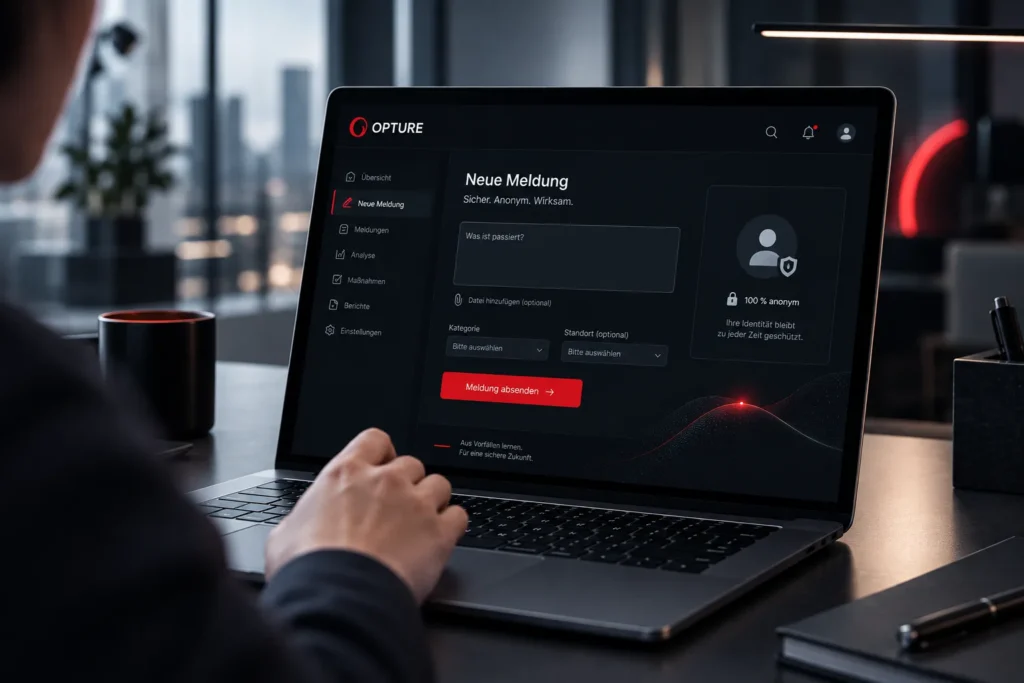
OPTURE CIRS is part of the RegOS platform (Regulatory Operating System).
This means: If a near miss reveals a structural corporate risk, this case can be seamlessly and without media disruption integrated into the Enterprise Risk Management (ERM) can be transferred. We do not offer an isolated database, but rather a holistic, audit-proof control model for international organizations, hospitals, and highly regulated industries.
Report without fear, minimize risks
OPTURE CIRS bietet einen klar strukturierten, digitalen Prozess, der jede Meldung revisionssicher dokumentiert und automatisch an die richtigen Stellen weiterleitet. Risiken werden früh erkannt, sauber bewertet und mit Maßnahmen verknüpft, sodass Unternehmen nicht nur schneller reagieren, sondern auch Haftungs- und Reputationsrisiken nachhaltig reduzieren. CIRS-Meldungen werden neben der Risikoprävention häufig auch zur Optimierung operativer Prozesse eingesetzt.
The end of the email chains
With OPTURE CIRS laufen Risikoanalysen, Incident Meldungen und Nachweisführungen vollständig automatisiert. Das entlastet Ihre Teams spürbar, minimiert manuelle Fehlerquellen und sorgt für konsistente, revisionssichere Abläufe. Gleichzeitig verkürzt die Automatisierung die Reaktionszeit bei Vorfällen massiv – Risiken werden früher erkannt, Maßnahmen schneller eingeleitet und Compliance Anforderungen zuverlässig erfüllt.
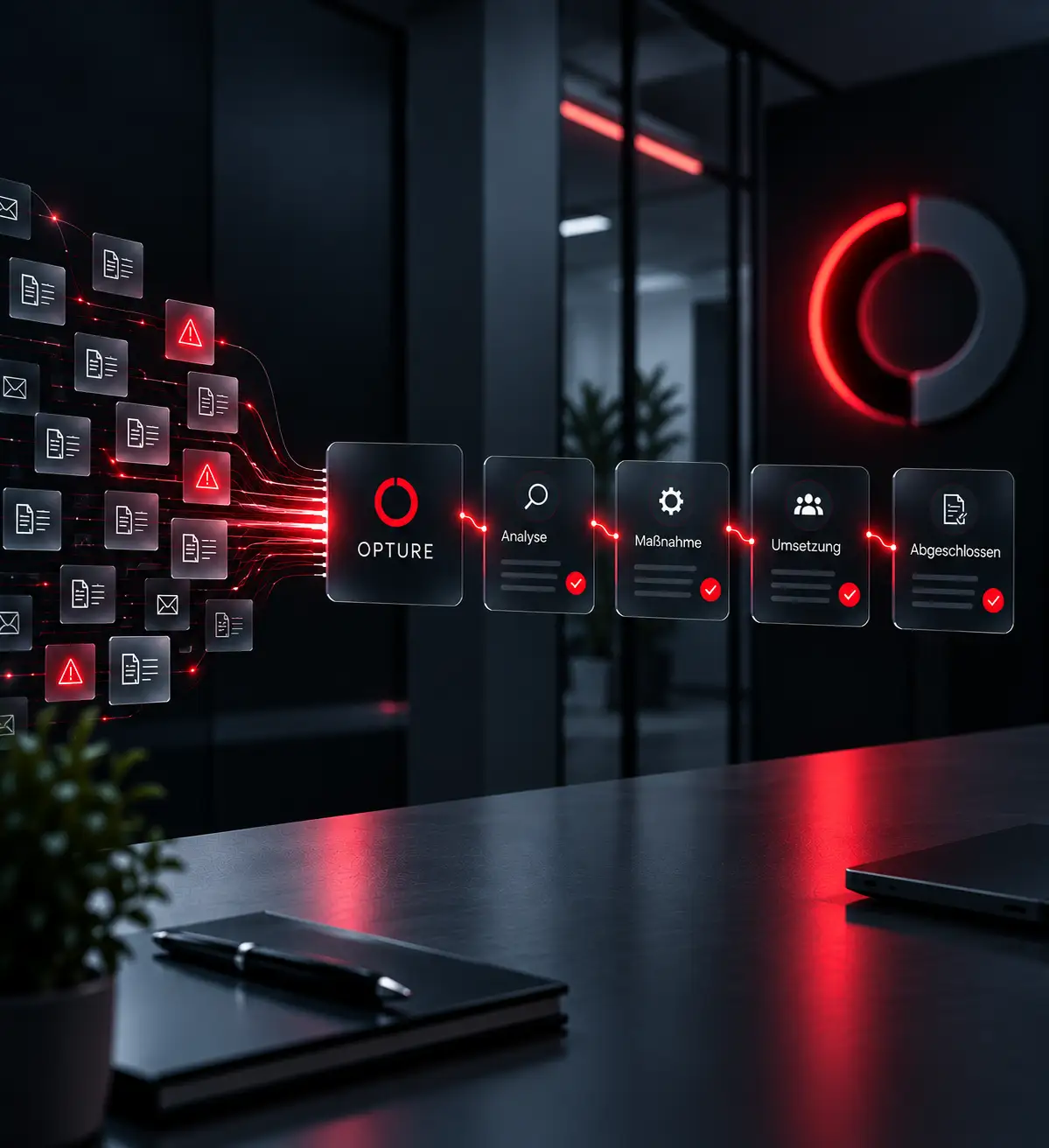
100%: Anonymous & Automated
Up to 30 % in cost savings through automation
With OPTURE CIRS laufen Risikoanalysen, Incident Meldungen und Nachweisführungen vollständig automatisiert. Das entlastet Ihre Teams spürbar, minimiert manuelle Fehlerquellen und sorgt für konsistente, revisionssichere Abläufe. Gleichzeitig verkürzt die Automatisierung die Reaktionszeit bei Vorfällen massiv – Risiken werden früher erkannt, Maßnahmen schneller eingeleitet und Compliance Anforderungen zuverlässig erfüllt.
- Audit-ready
- Strengthens the safety culture
- 100% Anonymity
- Automated case management
FUNCTIONALITY
From near-miss to systematic improvement
Every report helps drive greater safety and quality—reducing compliance efforts by 60%
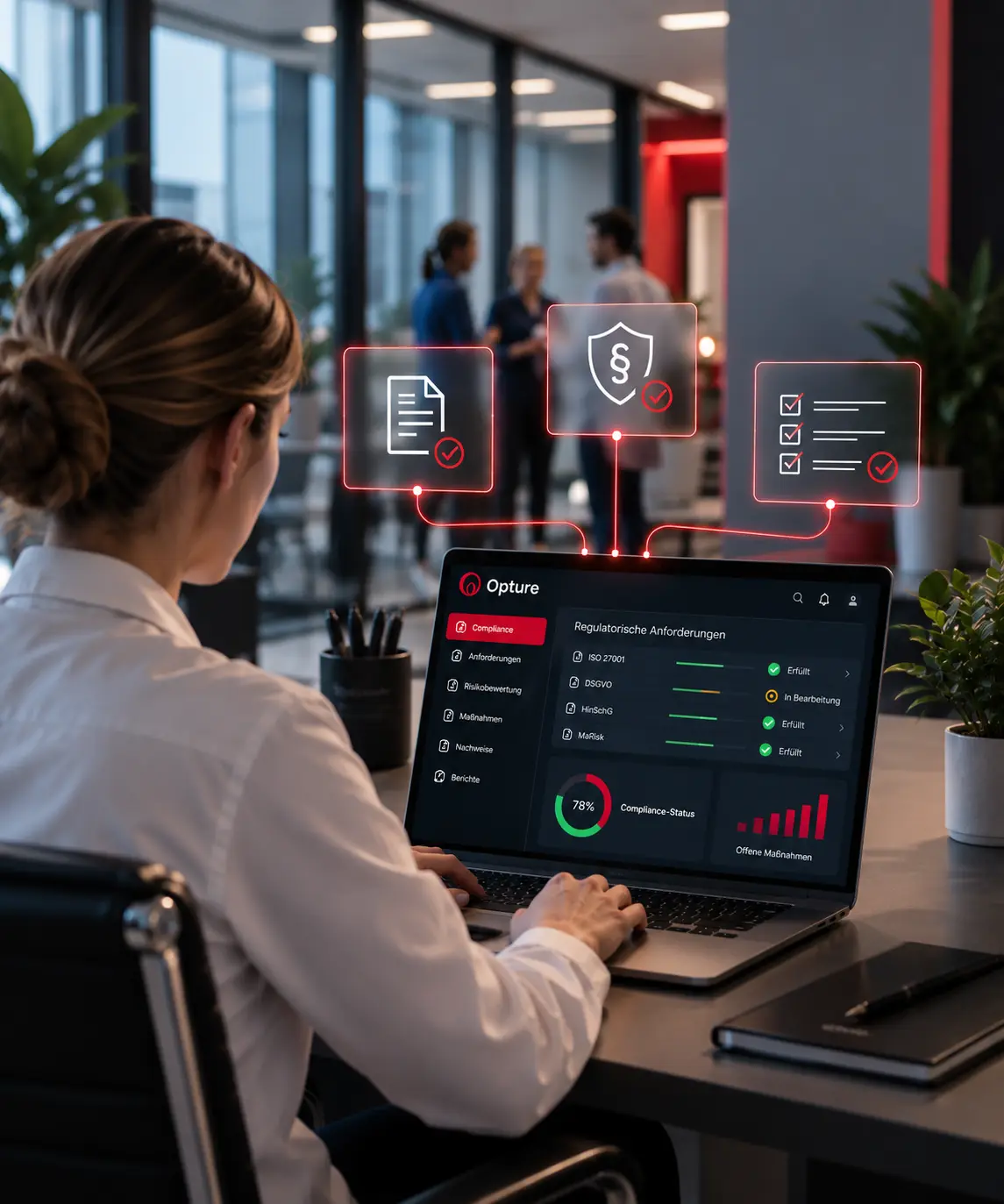
Internes Incident‑Management in einem System
OPTURE CIRS vereint eine moderne, barrierefreie Meldeseite mit einem leistungsstarken internen Fallmanagement. Alle Schritte – Eingang, Analyse, Maßnahmen, Dokumentation – laufen in einem durchgängigen Workflow.
- dialog function
- Status Updates
- escalation mechanisms
- Audit Trail
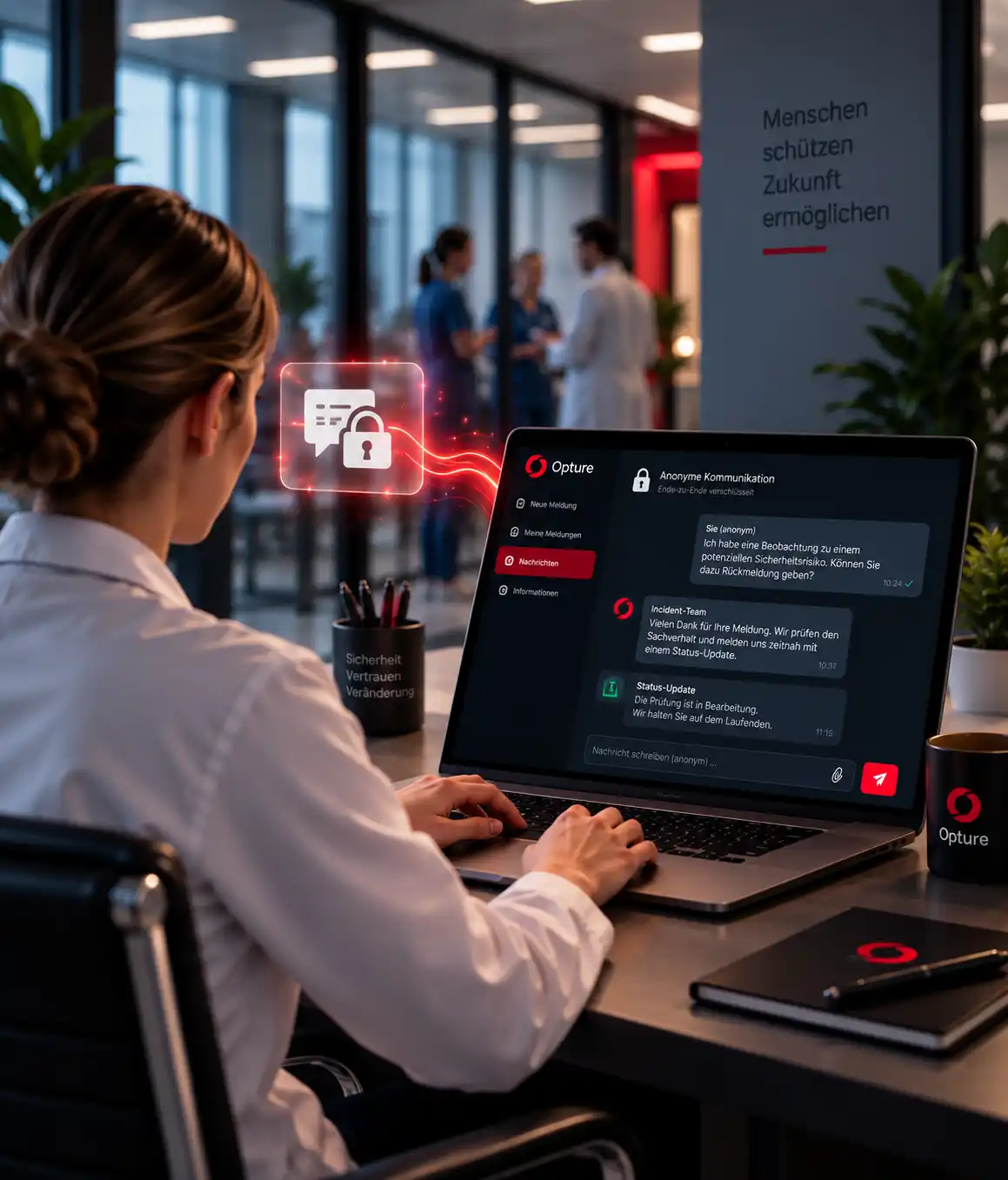
Anonymous two-way communication
Important details for root cause analysis are often missing. Your incident team can use a technically secured mailbox with a security key to send anonymous inquiries to the reporter. The reporter’s identity remains 100 % protected.
- dialog function
- Status Updates
- escalation mechanisms
- Audit Trail

Structured internal incident management
Incidents do not slip through the cracks. Every report triggers a defined workflow. Roles, responsibilities, and escalation paths ensure that a thorough root cause analysis takes place and corrective and preventive actions (CAPA) are derived.
- Anonymous report
- Secure communication
- Privacy & GDPR Compliance
- Whistleblower protection
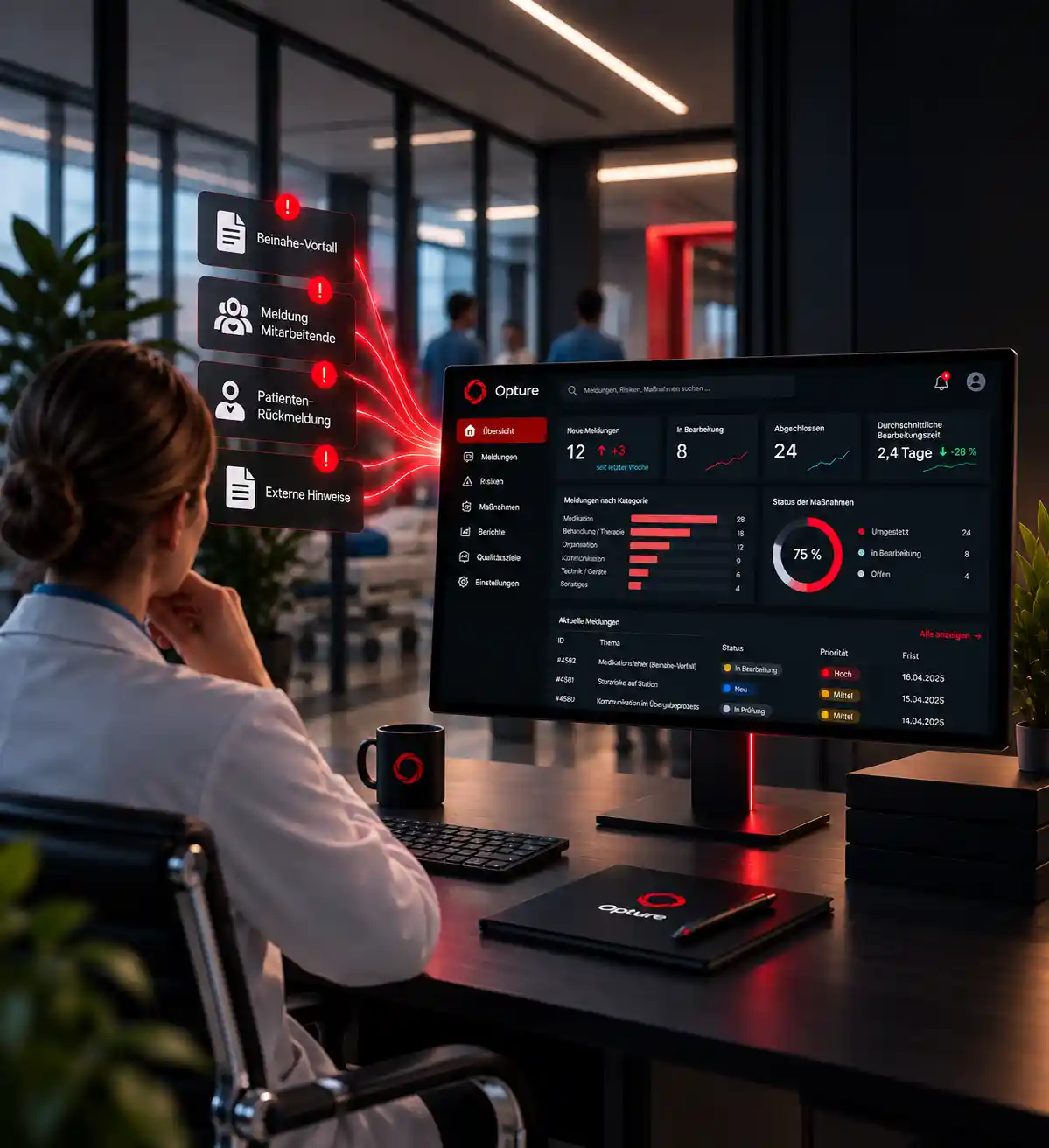
Proactive management instead of external escalation
Automated notifications and deadline monitoring allow you to quickly resolve critical incidents internally. This protects your reputation, prevents regulatory investigations, and ensures quality standards.
- early warning system
- Risk assessment
- Action management
- Reporting & Dashboards
How does OPTURE CIRS differ from our existing IT ticketing system?
Ein normales Ticketsystem ist für die Abarbeitung technischer Störungen gedacht. Es bietet in der Regel keine absolute, revisionssichere Anonymität und keine echten Zwei-Wege-Postfächer für Rückfragen an unbekannte Melder. Zudem fehlen die spezifischen Workflows zur Ursachenanalyse und zur Ableitung von strategischen Präventivmaßnahmen, die ein echtes CIRS auszeichnen.
How do you ensure that whistleblowers truly remain anonymous?
The architecture of our reporting page completely dispenses with the tracking of IP addresses, location data, or login requirements. Communication takes place via an encrypted token system. Even administrators cannot trace the identity of the whistleblower.
Can we customize the categories and the reporting form ourselves?
Yes, 100% %. Whether you want to track incidents related to patient safety, workplace safety, or product manufacturing—you can configure text, fields, categories, and the entire branding on your own in just a few minutes.
How does CIRS interact with the rest of the OPTURE platform?
How long does the implementation take in our company?
Da es sich um eine hochmoderne SaaS-Plattform handelt, gibt es keine monatelangen IT-Projekte. OPTURE CIRS ist innerhalb von 1 bis 2 Tagen einsatzbereit. Sie benötigen keine externen Dienstleister, um das System auf Ihre Prozesse anzupassen.
Deep Dive: CIRS as a Driver of Quality and Safety
A Critical Incident Reporting System (CIRS) supports companies and organizations in recording critical events, near misses, and safety-related observations at an early stage. The goal is not to assign blame, but to systematically learn from incidents before small deviations turn into real damage.
Particularly in regulated areas such as healthcare, industry, occupational safety, quality management, compliance, and HSE, CIRS is an important component of a modern safety and governance culture. The central task consists of recording reports in a structured manner, analyzing causes in a traceable way, implementing measures effectively, and making insights usable across the organization.
The core of CIRS: Critical events are not hidden, but used as valuable learning signals. This creates a culture in which risks become visible earlier and quality and safety increase sustainably.
From Error Message to No-Blame Culture
A CIRS only works if employees can report critical situations without fear of personal consequences. This No-blame culture is the basis for an effective reporting system. It is not about holding individuals accountable, but rather about making unsafe processes, missing controls, or organizational vulnerabilities visible.
A simple email inbox or an anonymous form is often not enough for this. Professional CIRS requires clear roles, protected communication channels, structured case processing, and the ability to ask follow-up questions without compromising the confidentiality of the reporter.
Which incidents a CIRS should record
A modern CIRS should not only document actual cases of harm, but above all those events that can serve as early warning signals. These include:
- Near-miss: Situations in which damage was prevented only by chance or through timely intervention.
- Critical incidents: Anomalies in processes, workflows, or controls that pose a safety or quality risk.
- Organizational vulnerabilities: Unclear responsibilities, lack of training, incomplete documentation, or poor communication.
- Recurring deviations: Incidents that occur multiple times and indicate systemic causes.
Root cause analysis instead of mere symptom treatment
The added value of a CIRS does not come from simply recording a report, but from analyzing the causes. If only the visible error is corrected, the actual risk remains. Therefore, every relevant incident should be evaluated in a structured manner and, if necessary, a Root Cause Analysis to be subjected to.
OPTURE CIRS supports this process through traceable workflows, clear responsibilities, and documented processing steps. This turns a single report into a structured improvement process.
CAPA: Actions, Effectiveness, and Follow-up
Following the root cause analysis, specific measures must be defined. This involves corrective measures to immediately resolve the problem and preventive measures designed to prevent it from happening again. This approach is known as CAPA Management known.
The effectiveness check is crucial. A case should not be closed simply because a measure has been recorded. True improvements in quality and safety only occur once it has been verified that the measure is actually effective.
System comparison: Email, Excel or OPTURE CIRS
| Requirement | E-Mail / Excel / Intranet form | OPTURE CIRS |
|---|---|---|
| Reporting and Confidentiality | Reports are often unstructured. Confidentiality, follow-up questions, and protection of the whistleblower are frequently only possible to a limited extent. | Structured reports, secure communication, and defined processing procedures support a trustworthy reporting culture. |
| Root cause analysis | Causes are often documented manually, inconsistently, or not systematically at all. | Workflows support a comprehensible analysis of causes, impacts, responsibilities, and measures. |
| Action management | Deadlines, responsibilities, and implementation statuses are often maintained separately and are difficult to track. | Measures, persons responsible, deadlines, escalations, and effectiveness checks are documented centrally. |
| auditability | Evidence is often scattered across emails, spreadsheets, or individual documents. | Every processing step remains traceably documented and can be used for audits, certifications, and management reports. |
| Integration in GRC | CIRS remains isolated and is not linked to risk, control, or compliance processes. | CIRS cases can be linked to risks, controls, measures, internal control systems (ICS), ERM, and compliance processes within the RegOS platform. |
From reporting channel to organizational learning database
The strategic value of a CIRS lies in its function as a learning system. Recurring incidents, typical causes, and effective measures are not forgotten, but are instead made systematically evaluable. This creates an organization-wide knowledge base for prevention, quality, and safety.
Management, quality managers, compliance teams, and business units receive a clear basis to identify critical developments at an early stage and take targeted countermeasures. In this way, CIRS evolves from a pure reporting channel into an active tool for continuous improvement.
CIRS creates safety through learning.
With OPTURE CIRS, critical events are recorded in a structured manner, their causes are analyzed transparently, and measures are effectively tracked. This creates an audit-ready foundation for quality, safety, and resilient governance.