Solutions
Leading in Information and Cyber Security (ISMS/NIS2)
Information Security Management System & Cyber Security (ISMS / NIS2). OPTURE ISMS/NIS2 combines proven ISMS standards (ISO) optionally with regulatory NIS2 requirements to create an integrated, intelligent security and resilience system – innovative, consistent and fully interconnected.
Customer Benefit
Intelligent ISMS/NIS2 combined - this is how integration works today
OPTURE ISMS/NIS2 and KRITIS is more than just an ISMS solution. It combines SBA, BIA and BCM for maximum information security and can be seamlessly combined with NIS2 for maximum cyber security as an option.
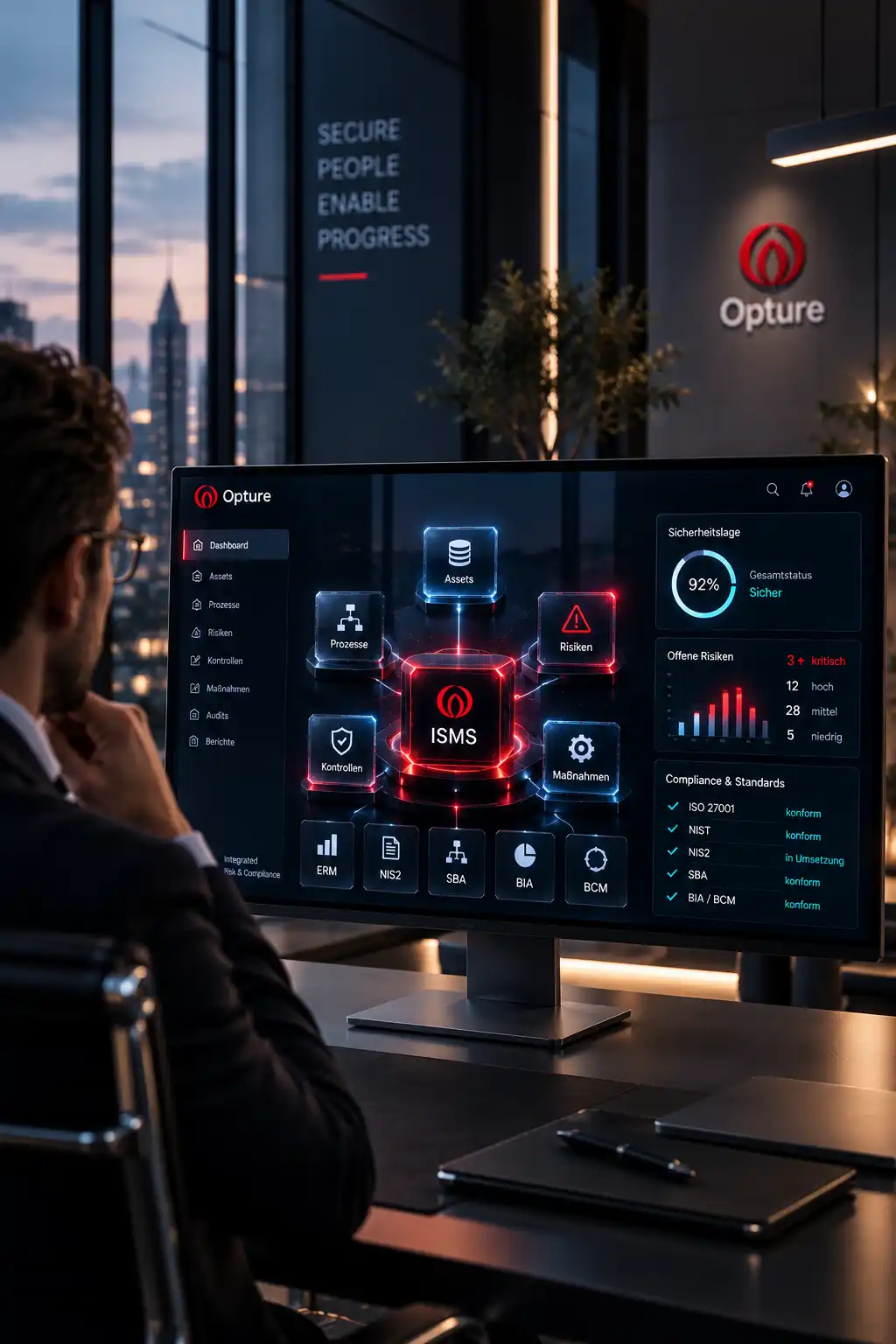
The core of information security
An integrated system that intelligently connects processes, assets, risks, and measures and fully integrates them with ERM, NIS2, KRITIS, SBA, BIA and BCM interconnected.
Structured security: According to ISO 27001, NIST and industry-specific frameworks.
Central Administration: Assets, risks, controls and measures – 100 fully % audited.
Automated workflows: For reviews, releases, escalations, and evidence.
Holistic governance: Direct integration into ERM, IKS and compliance.
Real-time transparency: Always have an overview of the current security situation.
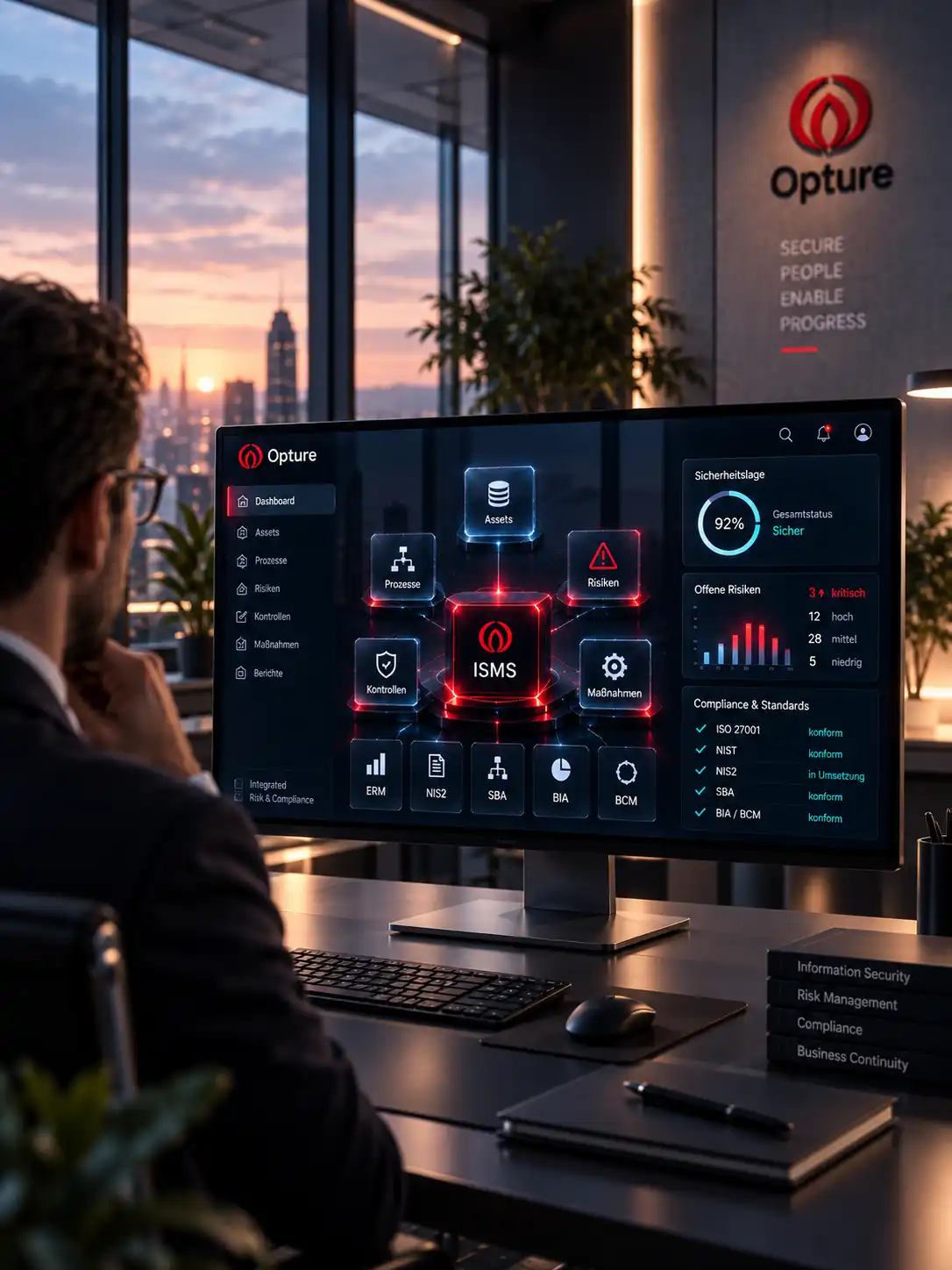
Accurate evaluation for critical decisions
The reliable basis for accurately evaluating critical processes, assets, and their dependencies.
Systematic evaluation: Of the impact on availability, integrity, confidentiality and compliance.
Recognizing criticality: Identification of assets and processes as the basis for protection needs.
Automated derivation: Of concrete measures and levels of security.
Complete documentation: Perfectly prepared for audits and NIS2 certificates.
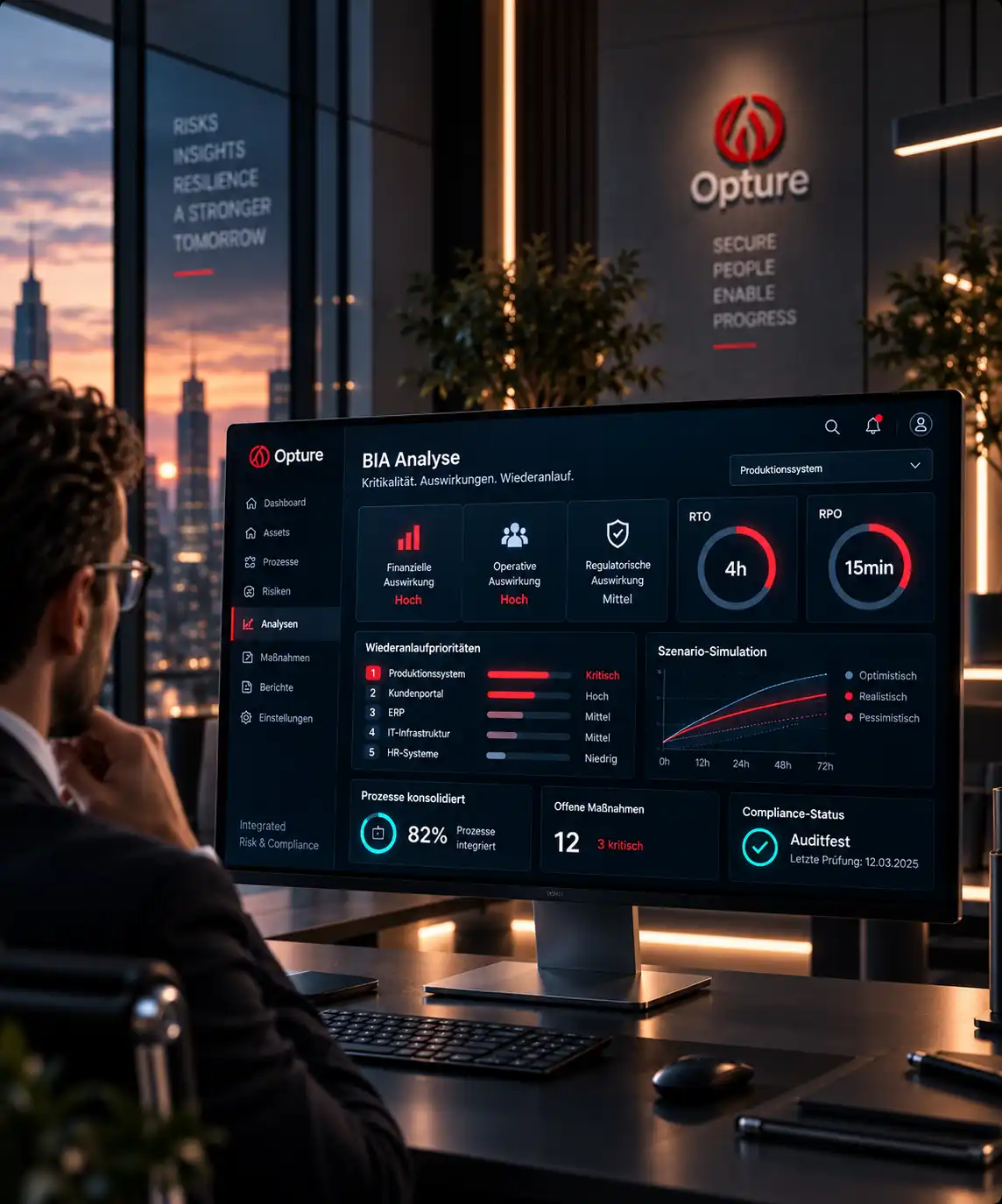
Make resilient decisions under pressure
OPTURE BIA deeply integrates the impact, recovery times, and process criticality.
Failure assessment: Analysis of financial, operational and regulatory impacts.
Clear definitions: Accurate determination of RTO/RPO values and resume priorities.
Automated consolidation: Of process dependencies, resources, and IT systems.
Ensure compliance: Transparent, audibly-proof documentation.
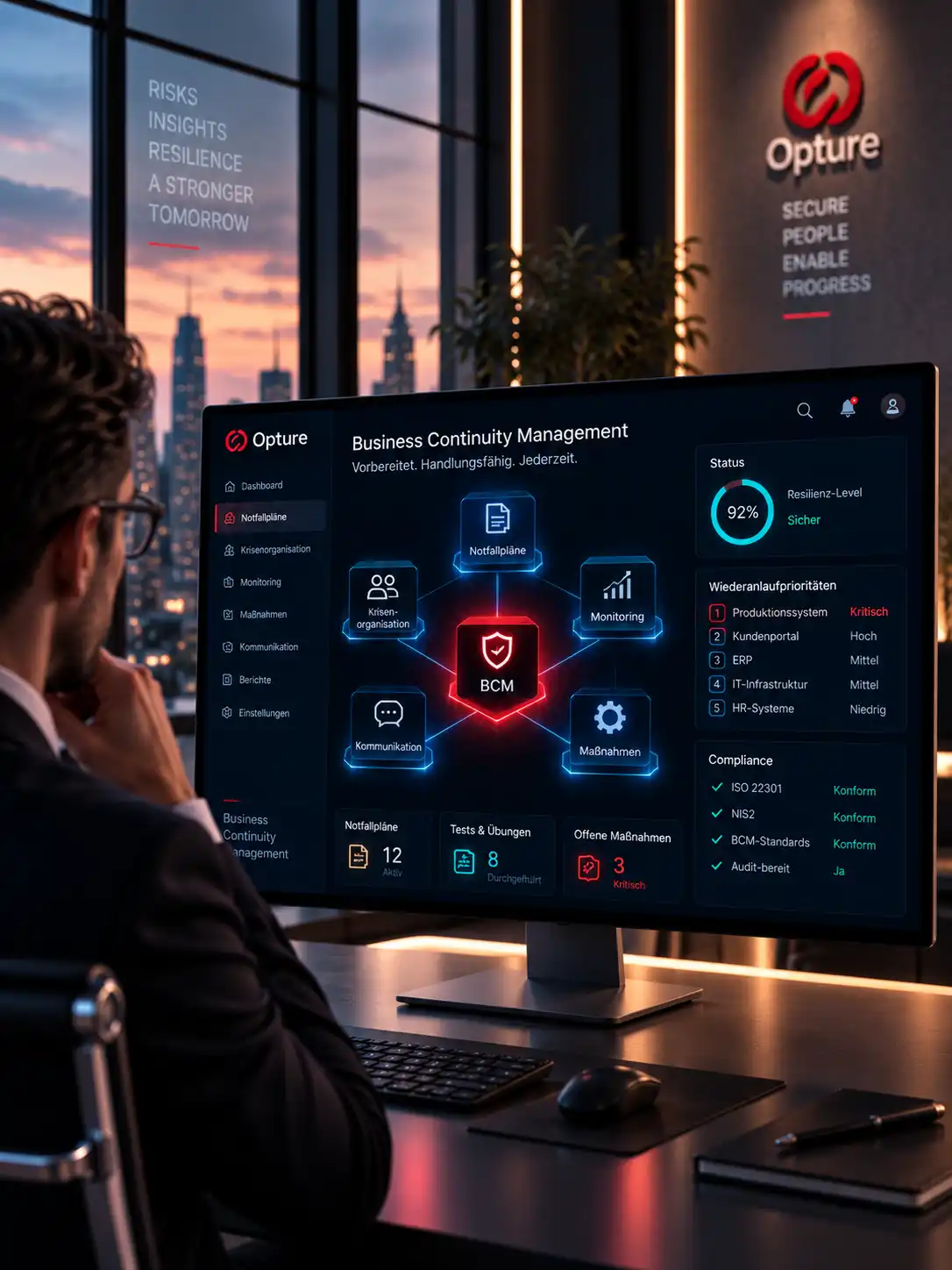
Integrated resilience for emergencies
BCM (= Business Continuity Management) combines emergency planning, recovery strategies, and crisis management in a central system.
Digital emergency plans: Creation, maintenance, and automation of recovery strategies.
Crisis organization: Structured roles, escalations, and communication paths.
Real-time monitoring: Actions, availability, and status at a glance.
Digitalization & Security of Assets
Up to 60 % cost savings
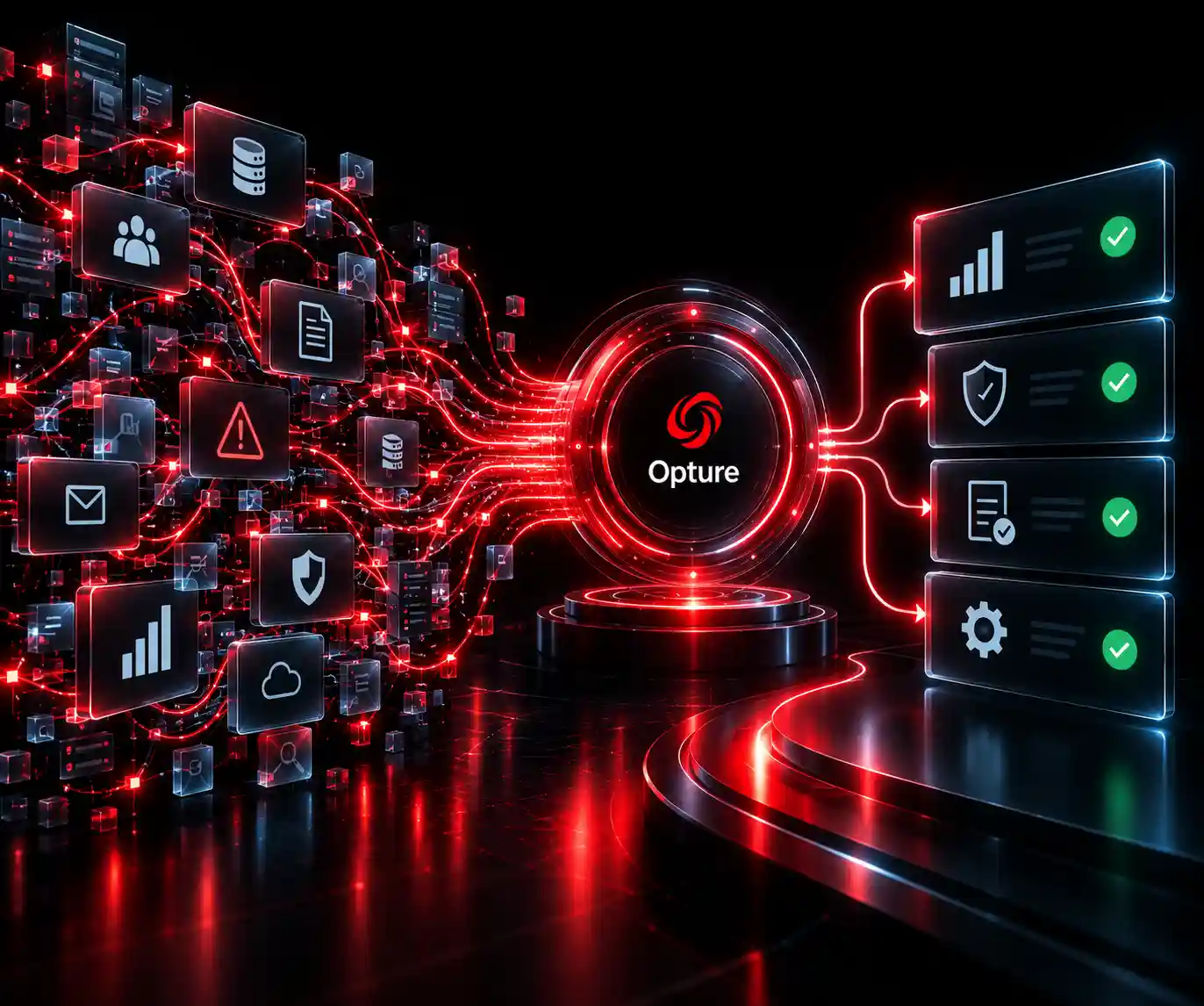
Digitize and automate your security processes. With OPTURE ISMS/NIS2, companies gain full transparency, massively reduced costs, and a robust foundation for cybersecurity and business continuity.
Holistic control instead of isolated tools
Bring all resilience topics together in one place. No media gaps, no redundant data collection.
Automated processes
Risk analyses, incident processes and reporting are automated. This relieves responsibility and reduces the error rate.
Full transparency
With the click of a button, you can see which processes are critical and where there are dependencies. Decisions are based on facts and are reliable and verifiable.
Integrated NIS2 compliance
The platform automatically monitors deadlines and reporting chains. Meet regulatory obligations efficiently and without the risk of interpretation errors.
Robust business continuity
Quick response in the event of a crisis through up-to-date, tested, effective and customer-specific emergency plans at all times.
Future-proof architecture
Ready for DORA, KRITIS updates or CSDDD. The system grows with your requirements, without expensive system disruptions.
How is OPTURE ISMS/NIS2 integrated into the OPTURE RegOS platform?
Is it possible to separate OPTURE ISMS and OPTURE NIS2?
Yes, that is basically possible. ISMS (e.g., according to ISO 27001) is the methodological basis and already covers approximately 70–80 % of the NIS2 requirements. NIS2 is legally binding and focuses on specific reporting channels, deadlines, and proofs to authorities. Both can be used separately or in perfect combination.
What specific benefits does this software offer me?
Unlike isolated tools, OPTURE provides a structured governance design and a relational data model. This makes the solution scalable and extremely powerful, especially for complex and regulated organizations.
How does OPTURE support the implementation of the NIS2 directive?
All obligations – from governance to incident reporting to the supply chain – are systematically documented. The platform automatically monitors deadlines and provides you with a 100% % audit-proof compliance structure.
How do the SBA, BIA and BCM work together in OPTURE?
SBA defines protection needs, BIA assesses process criticality, and BCM controls recovery strategies. OPTURE ISMS automatically links these disciplines. All dependencies and resources flow into a common, robust resilience model.
How quickly can OPTURE ISMS/NIS2 be implemented?
Typically within a few weeks, depending on your level of maturity. We provide clear roles and processes right away, so you don’t have to start from scratch.
What is an Information Security Management System (ISMS)?
In an era characterized by sophisticated cyber threats such as ransomware-as-a-service, state-sponsored hacking, and sophisticated social engineering, a strong firewall is no longer enough. Information Security Management System (ISMS) the form of The organizational backbone of a company’s cybersecurity. It is a systematic set of rules, guidelines, processes, and procedures designed to proactively manage, monitor, and continuously improve information security.
While things are Cyber Security Primarily operational and technical While focusing on protection measures in the digital world, an ISMS goes a long way beyond that. It also covers organizational security, physical security, personnel security, and the management of third-party providers.
The central objective of an ISMS, usually based on the standard ISO/IEC 27001, is the guarantee of the three classical Protection objectives of information security: Confidentiality (Confidentiality), Integrity and Availability. With this, an ISMS protects information not only technically but also organizationally, procedurally, and based on risk assessment.
The European NIS2 Directive: The Game Changer for Top Management
With the introduction of the European NIS2 Directive (Network and Information Security Directive 2) has significantly tightened the regulatory landscape for IT security. The directive aims to ensure a high common cybersecurity level across the EU. It no longer only applies to classic KRITIS operators (Critical Infrastructure), but extends its scope to tens of thousands of companies across 18 sectors – from the manufacturing industry to logistics and food production.
The Brillant of NIS2: Cyber security is now inevitably a matter for the bosses. Managing directors (board members, managing directors) are personally required to approve the risk management measures in the field of cybersecurity and to monitor their implementation. Failure to comply carries not only draconian fines for companies but explicitly also the personal liability of the management team and temporary professional bans.
| NIS2 requirement | Importance for Cyber Security & the ISMS | Possible sanctions for violation |
|---|---|---|
| Risk management & ISMS | Obligation to implement robust risk analyses, Business Continuity Management (BCM) and Incident Response Plans. An ISO 27001-compliant ISMS is practically a prerequisite. | Fines of up to €10 million or 2 % % of global annual turnover in essential facilities. |
| Reporting obligations (Incident Reporting) | Extremely strict requirements for security incidents: First report (Early warning) to the competent authority within 24 hours, Detailed report within 72 hours. | High fines and reputational damage caused by government publications. |
| Supply chain security (supply chain) | Companies must strictly review and audit the safety standards of their direct suppliers and service providers. | Contractual penalties, loss of certification and disruption of operations. |
| Management liability (duty to approve) | The management must regularly undergo training in cyber security and is liable for damages caused by a breach of duty, for example in the absence of an ISMS. | Personal internal suspension as well as possible suspension of the management function. |
Architecture of an ISMS: The ISO 27001 framework
A compliant ISMS cannot be purchased and installed in a one-time transaction. It requires a dynamic lifecycle to be able to respond to the constantly changing threat landscape. ISO 27001 uses the proven PDCA cycle for this purpose.
[NIS2 Compliance & Management (Governance)]
                       │
                       ▼
          ┌───────────────────────────┐
          │INFORMATION RESOURCES│
          │(Hardware, Software, Data)│
          └─────────────┬─────────────┘
                       │
      ┌─────────────────▼─────────────────┐
      1. RISK ASSESSMENT (Risk analysis)
      │Identification of vulnerabilities│
      │ & Cyber Threats (Ransomware etc.) │
      └─────────────────┬─────────────────┘
                       │
      ┌─────────────────▼─────────────────┐
      │2. SECURITY CONTROLS (Measures) │
      Implementation of TOMs, MFA, Zero
      │Trust, Network Segmentation │
      └─────────────────┬─────────────────┘
                       │
      ┌─────────────────▼─────────────────┐
      │ 3. MONITORING & SIEM │
      │ 24/7 monitoring of log data, │
      │Anomaly detection, SOC connection │
      └─────────────────┬─────────────────┘
                       │
      ┌─────────────────▼─────────────────┐
      │4. INCIDENT RESPONSE & BCM │
      │ Emergency plans, forensics, re-
      │contact point, 24-hour reporting obligation │
      └───────────────────────────────────┘
Practical example: The emergency – A ransomware attack
The theory of information security management becomes most tangible when one considers the worst-case scenario: A salesperson opens the attachment of a perfectly fake phishing email on a Friday afternoon. In the background, ransomware begins encrypting the network drives, servers, and backups. The ransom demand appears on the screens.
Scenario A: The company without a professional ISMS
It breaks organizational chaos Out. The IT department is pulling out Panic over network cables. The management only learns about the extent of the problem hours later, because there are no defined escalation chains. There is no printed emergency plan; the contact details of the IT forensics service provider are encrypted on the inaccessible server. The legal 24-hour reporting obligation under NIS2 is missed. Customers are not informed in time; production is down for weeks. The result: an existential financial damage, a destroyed corporate image and a regulatory authority that initiates a personal liability procedure against the management.
Scenario B: The company with software-based ISMS & NIS2 readiness
The SIEM system immediately issues an alert due to suspicious encryption activity. An automated system Incident Response Workflow The ISMS software is launched. The system automatically isolates the infected network segment. The crisis management team will be notified via a separate communication channel.
Since that Asset management the IT department knows that the software is up-to-date Immediately, which critical systems are affected and that redundant offline backups are intact. The CISO opens the crisis manual via his tablet. Pre-made notification forms for authorities are generated within the first 24 hours and sent out in a timely manner. The management can subsequently fully document that legal and regulatory requirements have been met.
Why Excel is not enough: The need for specialized ISMS software
Cyber security is today a highly complex field that involves data intensive processes. Those who try to manage hundreds of IT assets, thousands of vulnerabilities, complex supply chains and strict reporting obligations in spreadsheets quickly encounter professional and organizational limits. A specialized ISMS software is the way to strategically scale up security:
- Holistic asset and risk management: IT systems, business processes and identified vulnerabilities are interconnected to calculate the actual business impact of IT risks.
- NIS2 and ISO 27001 compliance: The standards and guidelines in place allow for an efficient mapping of measures. An implemented security measure can therefore cover several requirements simultaneously.
- Real-time reporting for management: The CISO and the management receive dashboards, KPIs and KRIs to monitor the current situation. Monitor the security situation and compliance with the risk appetite.
- Supplier risk management: Safety questionnaires, evaluations and proof from suppliers can be managed and documented in a structured manner.