Solutions
AI Act Software: This is how to ensure AI compliance legally and automatically
Avoid fines of up to 35 million euros. OPTURE AIA is your central governance platform for the full implementation of the EU Artificial Intelligence Act.
Customer Benefit
Legal certainty for the enterprise-wide use of AI
The EU AI Act does not tolerate gray areas. Companies must be able to precisely demonstrate where and how artificial intelligence influences decisions. OPTURE AIA provides the structure for this.
Systematically prevent fines
Violations of the EU AI Act will be severely punished in the future. Our OPTURE AIA software safeguards your Compliance systematically removes it and provides the management with reliable evidence that can be audited.
Stable governance structures
Clear roles and clear responsibilities. OPTURE AIA defines escalation paths for AI deployment, thereby reducing personal liability risks for management.
The OPTURE advantage
Transparency about the "black box"
We make AI decisions understandable. Document fully where models are used, which data sources are involved, and where humans retain final control („Human Oversight“).
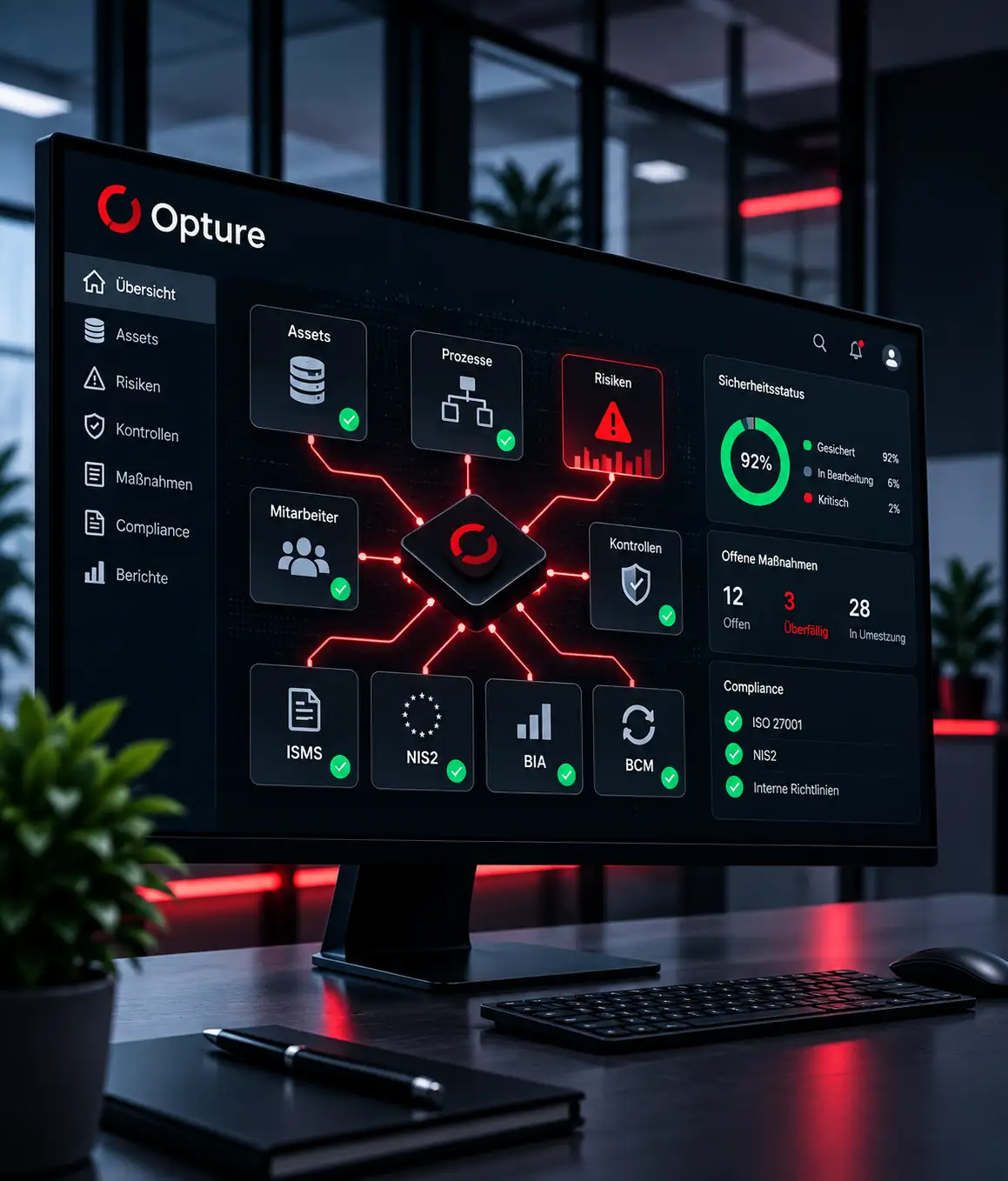
- Clear AI inventory
- Quick AI overview
- Vulnerability analysis
REGULATORY PRECISION
A governance design that goes beyond checklists
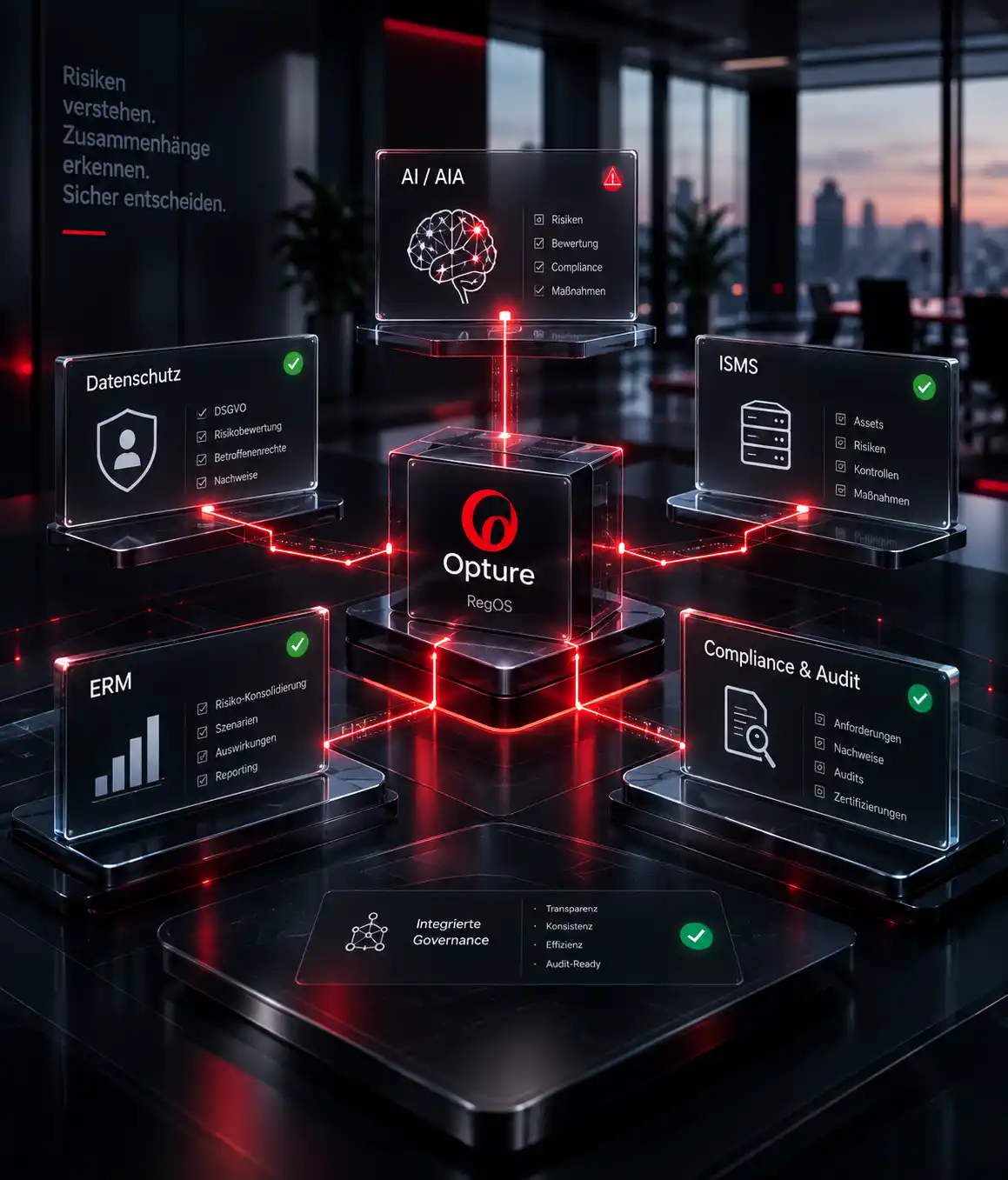
The market is currently flooded with isolated AI Act tools that are little more than digital Excel spreadsheets. OPTURE AIA goes deep. We offer a methodically clean, relational data model that directly addresses AI risks with your existing IT security (ISMS) and Risk management linked.
Since OPTURE AIA is natively installed on RegOS-Platform (Regulatory Operating System) runs, no new data silo is created. If an AI poses a GDPR or information security risk, this is immediately reported in the privacy and data protection modules. ERM (Enterprise Risk Management) mirrored. The result: Certification and audit-ready by design.
FUNCTIONALITY
From classification to continuous monitoring
Inventory, classify, and monitor all AI systems audibly – seamlessly integrated into your existing risk management.
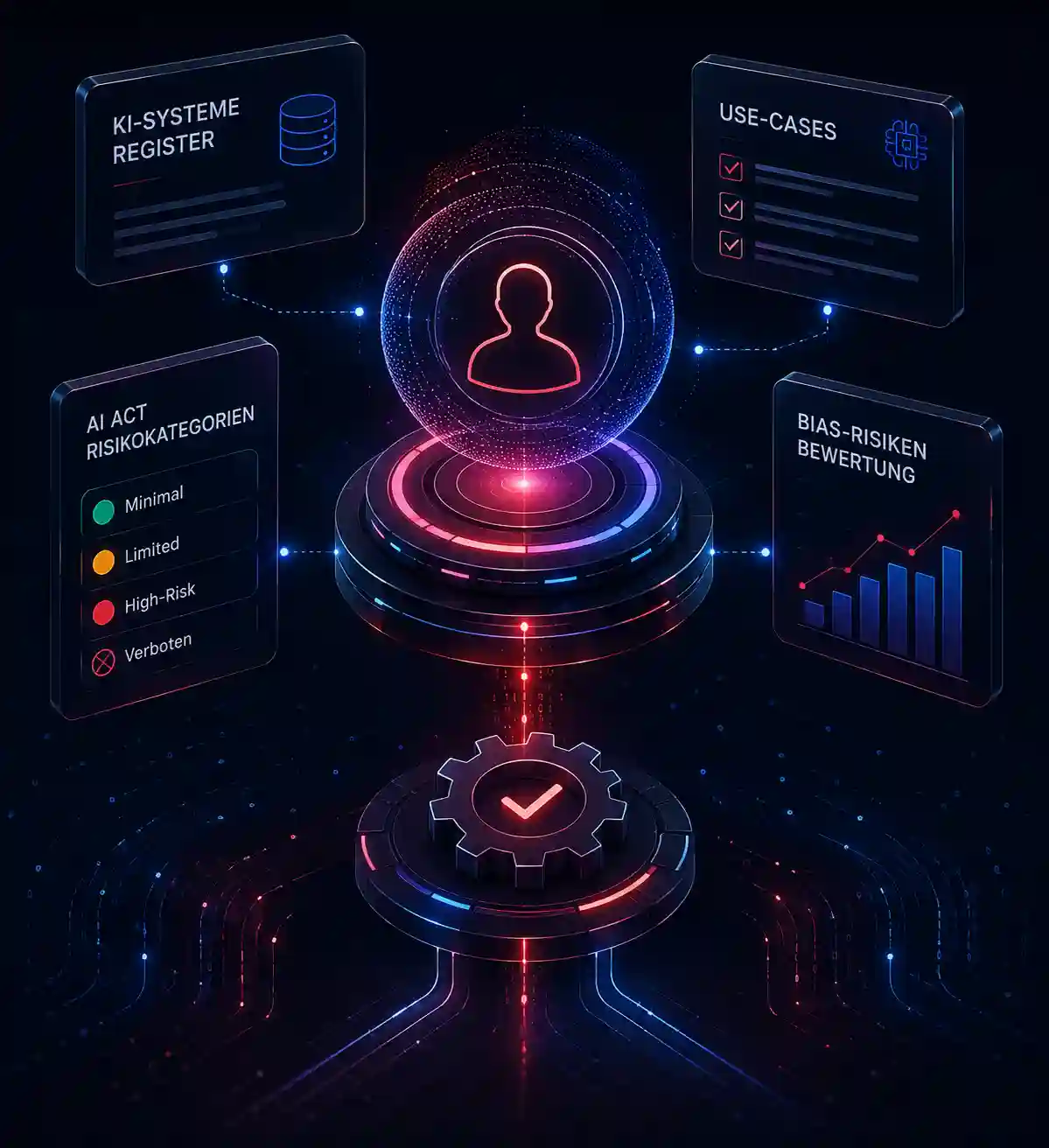
Risk classification & system inventory
Capture all AI systems in a central register. The software automatically assigns your use cases to the AI Act risk categories (Minimal, Limited, High-Risk, Prohibited) and accurately evaluates potential bias risks.
-
Central overview of all AI systems
-
Automatic AI Act classification
-
Precise bias risk analysis
-
Secure foundation for compliance and audits
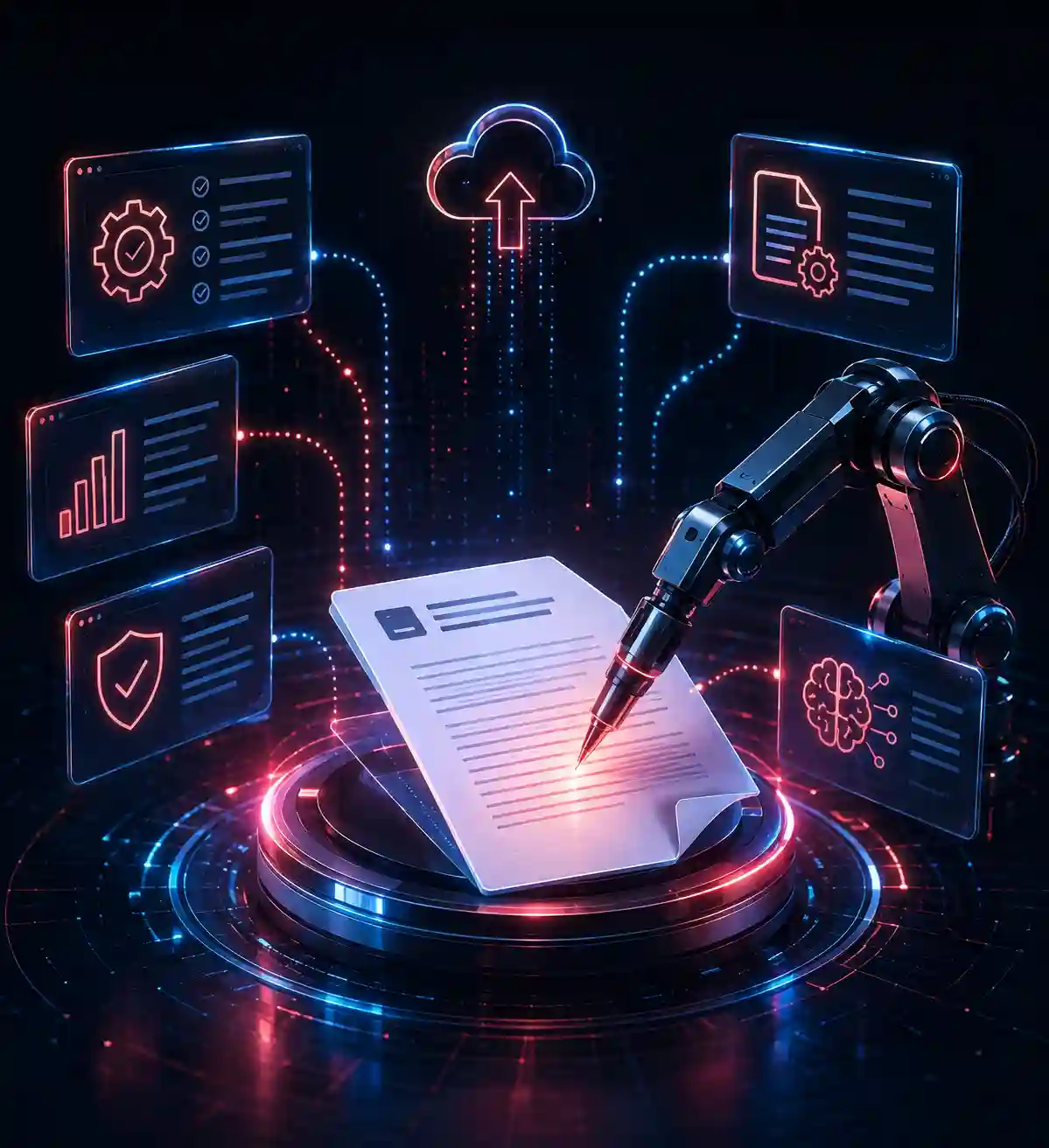
Automated technical documentation
Save months of manual writing work. OPTURE AIA automatically generates and updates the required technical documentation for high-risk systems – from the model architecture to the training data used.
-
Massive time savings
-
Consistent and legally sound documents
-
Automatic updates when models change
-
Reduction of errors and inconsistencies
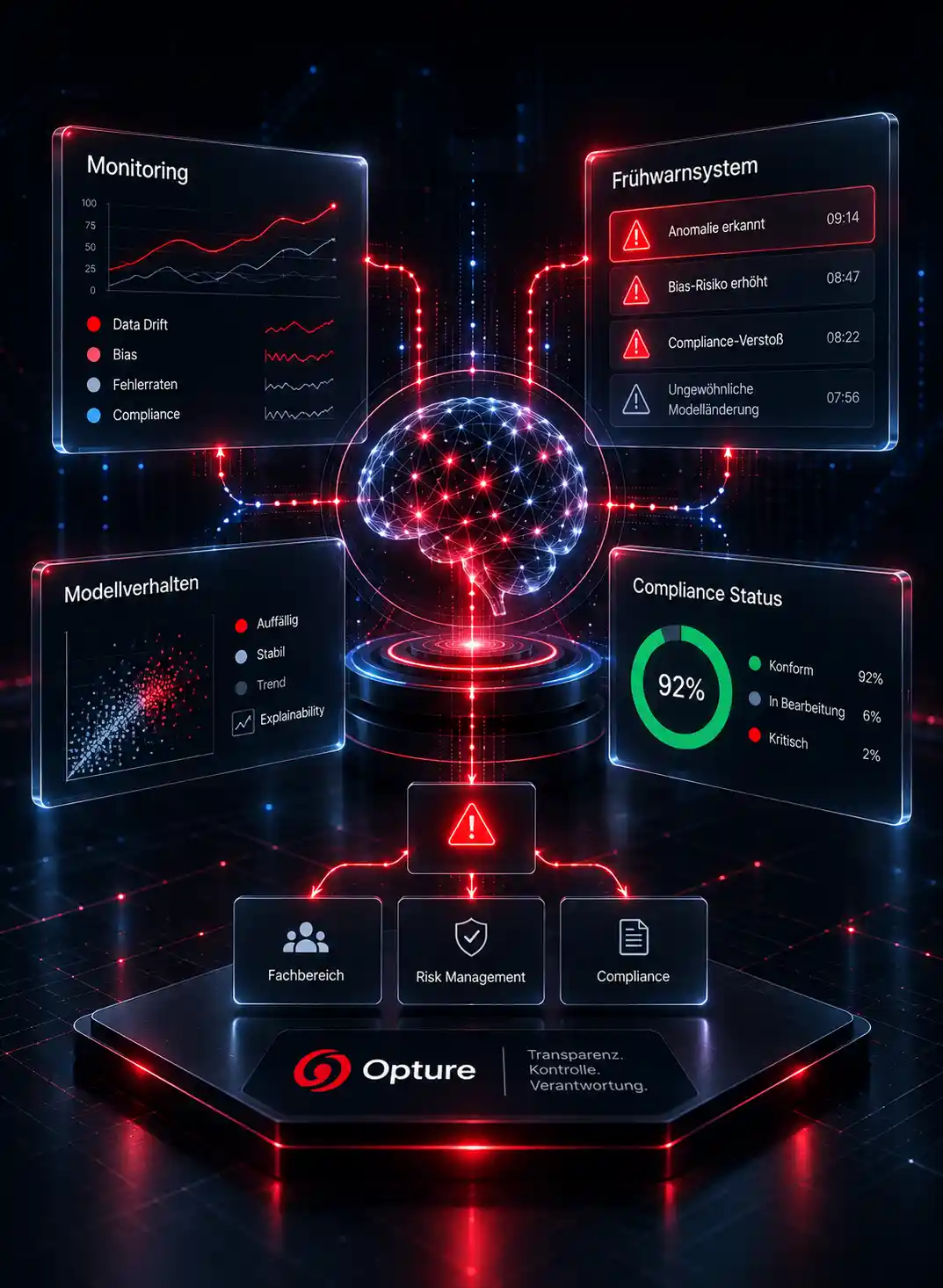
Monitoring & model behavior
AI changes continuously during operation. The software continuously monitors factors such as data drift, bias, and error rates. Deviations and Compliance- Violations are escalated immediately to the responsible parties via early warning systems.
-
Continuous monitoring of critical model parameters
-
Early warning system for compliance violations
-
Transparency about model behavior
-
Faster reaction to critical changes
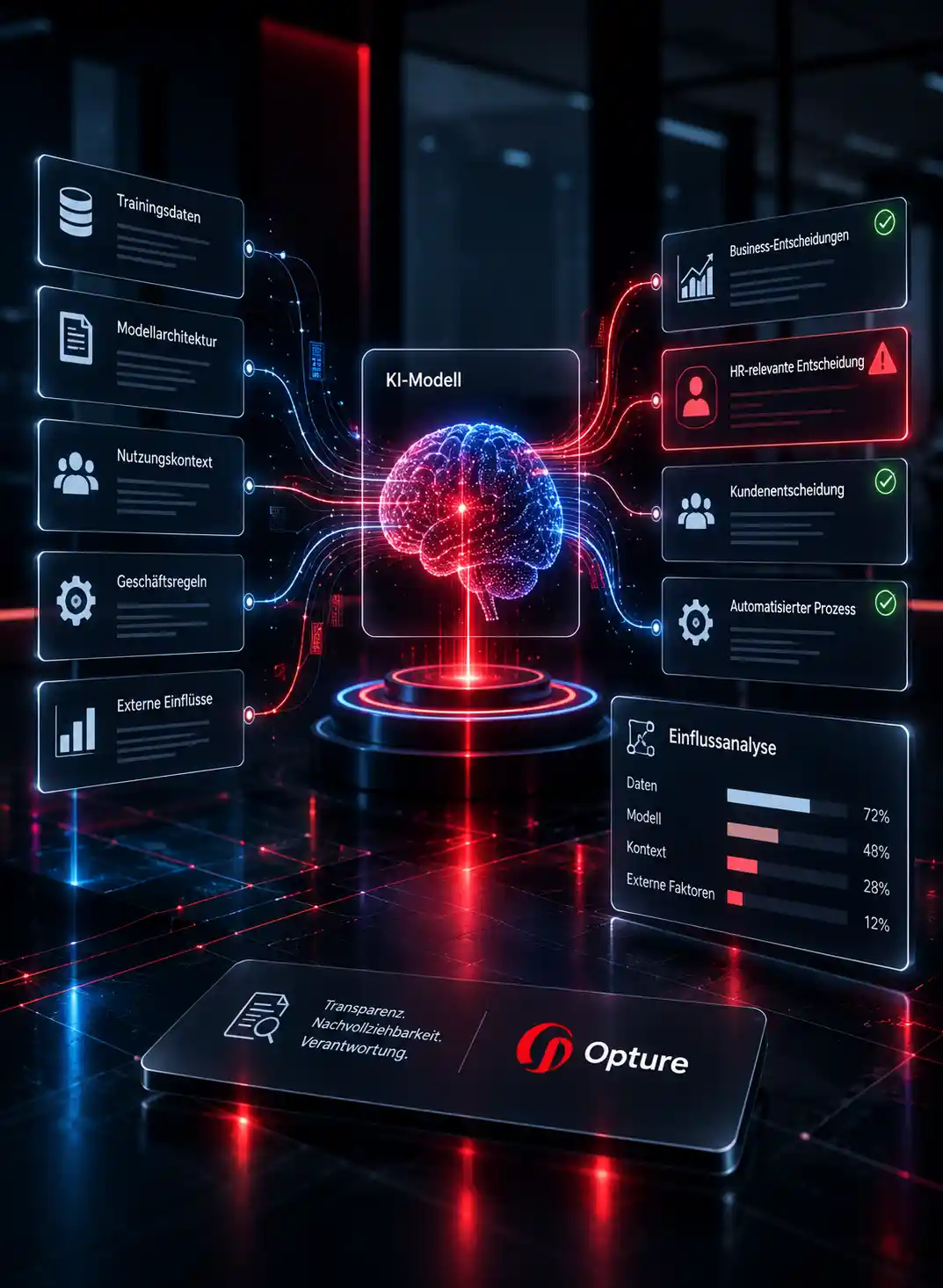
Influence analysis of AI decisions
Comply with strict transparency and explainability obligations. Documentably demonstrate how automated models influence business or HR-related decisions.
-
Compliance with transparency obligations
-
Understandable decision logic
-
Explainability for management and the supervisory board
-
Reduction of regulatory risks
How does the software help us classify AI systems?
The EU AI Act divides AI into four risk categories. OPTURE AIA guides you through structured, automated queries to identify the purpose, data sources, and model type of each system. The system then assigns the application to the correct category, allowing you to immediately know which legal obligations (e.g., for high-risk AI) apply to you.
What happens if our AI model changes over time?
This is where manual Excel lists fail. Our solution offers continuous monitoring. If the model behavior changes (e.g., due to data drift) or new training data are used, the system detects deviations and automatically triggers a review process to correct them. Compliance-Ensure compliance.
Do we need to build a completely new risk management system for the AI Act?
No. OPTURE AIA is fully integrated into OPTURE as a module. RegOS-Platform embedded. This means that the risks from the use of AI are seamlessly integrated into your existing Enterprise Risk Management (ERM), Yours ISMS or you Compliance-Module flow. There are no media breaks.
We have many different AI systems in use. Is the tool scalable?
Absolutely. OPTURE has been specifically designed for complex and medium-sized organizations. Whether you operate 10 or 500 KI systems across multiple subsidiaries – the platform’s multi-entity structure remains performant and consistent.
How quickly can we start implementing it?
Since we bring standardized processes based on the final legislative text, there is no need for a week-long consulting process. Depending on the number of your AI systems, the software is usually implemented and ready for productive use within 2 to 4 weeks.
Deep Dive: Why the EU AI Act requires dedicated governance software
The adoption of the EU Artificial Intelligence Acts (EU AI Act) It marks a turning point in global technology regulation. What began as a broad guideline is now a strict law with extraterritorial effect. For executives and compliance officers, this means the era of uncontrolled experimentation with artificial intelligence (shadow AI) is over. Anyone who develops, adapts, or uses AI systems on a corporate level must implement deep AI risk management.
The risk of fines and the limits of Excel
The sanctions for non-compliance with the AI Act even put the GDPR to shame. With penalties of up to 35 million euros or 7 % % of global annual revenue, AI compliance is coming to the forefront of management’s focus. One of the biggest challenges is the so-called Inventory (AI inventory) and the classification into the four risk categories (Inacceptable risk, High risk, Limited risk, Minimal risk).
Many companies are currently trying to model this classification in spreadsheets. The problem: AI systems are dynamic. A model that is classified as low risk today can suddenly fall into the "high-risk" category (high-risk AI) through an update or new training data. Without an automated technical system like the OPTURE AIA Software these deviations remain unnoticed until the auditor is standing in front of the door.
High-Risk AI: Technical Documentation and Human Oversight
If a system falls into the high-risk category (e.g., AI in recruiting, for lending, or in critical infrastructure), drastic measures are taken. The OPTURE AIA software digitally digitizes this pain point:
- Automated documentation: The system continuously generates the technical documentation (Article 11 AI Act), which includes the model architecture, system parameters, and evaluation metrics.
- Explainability and bias control: Companies must demonstrate that their AI is not biased. The software monitors data sources and model behavior to escalate regulatory violations early on.
- Human Oversight: The software documents in full detail where in the process a human reviewer can intervene to override AI decisions.
Integration instead of a one-size-fits-all solution: The RegOS advantage
The perhaps biggest mistake in implementing AI compliance is creating a new data silo. Artificial intelligence touches on data protection (GDPR), information security (ISMS/NIS2), and general corporate risks (ERM). A standalone "AI Act App" cannot capture these interconnected aspects.
| Approach | Isolated AI Act Tool | OPTURE AIA (RegOS) |
|---|---|---|
| Data model | Flat checklists without any connection to the overall company. | Relational model: Linking AI systems with business processes. |
| Risk escalation | Visible only within the AI team. | Direct escalation to the central ERM of the management. |
| Future security | This often has to be updated when new laws (e.g. the AI Liability Directive) come into effect. | Modular platform architecture that grows with new guidelines. |
By being embedded in the Regulatory Operating System (RegOS) OPTURE establishes a holistic governance framework. This enables corporations and SMEs to advance innovation through artificial intelligence without falling into legal pitfalls or compromising their audit capabilities.