Home » Industries » chemical industry
Compliance and risk management for the chemical industry
With the OPTURE RegOS Chemical companies can manage plant, environmental, hazardous material, supply chain, and compliance risks in an integrated, transparent, and audit-proof manner. This allows them to centrally manage regulatory requirements and operational risks.
OPTURE REGOS FOR CHEMICAL COMPANIES
Resilient protection of chemical processes
How chemical companies manage regulatory requirements, production risks, plant and safety risks, supply chain dependencies, and compliance obligations with integrated platform technology and modern risk management transparently and resiliently.
Highly complex production and plant processes
Continuous and batch-based production, reactor safety, process control technology, hazardous material handling, and energy supply are closely intertwined. This complexity requires centralized governance structures and complete transparency regarding risks and responsibilities.
Hazardous substances, environmental requirements & compliance pressure
Handling toxic, explosive, or environmentally hazardous substances requires strict safety, environmental, and compliance processes. A lack of transparency and violations lead to significant economic risks, liability risks, and reputational risks.
Global supply chains & raw material dependencies
Chemical precursors, catalysts, specialty raw materials, and energy come from global supply chains. Shortages, geopolitical risks, price volatility, and quality issues directly impact production, operations, and costs.
Industry Profile & Regulatory Baseline
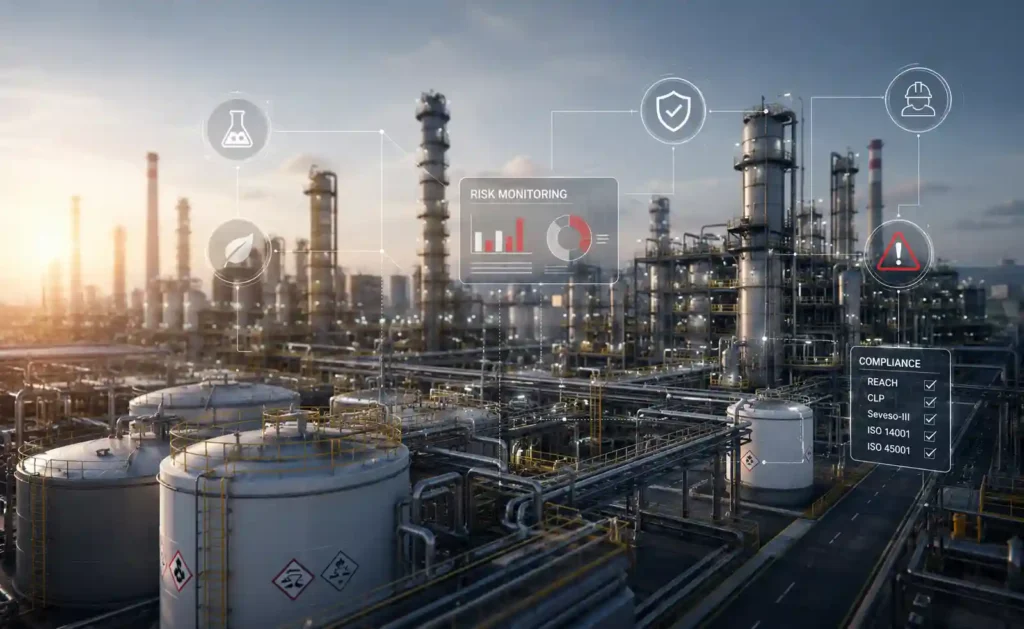
REACH, CLP, the Seveso III Directive, the Hazardous Substances Regulation and ISO standards (9001/14001/45001) determine the regulatory environment of the chemical industry, complemented by stricter regulations. NIS2-, KRITIS– and ESG reporting-Obligations.
This increases the pressure on chemical companies’ marketing departments to ensure complete documentation, transparent traceability, and continuous auditability.
Only a comprehensive overview of all interfaces and responsibilities enables companies to safely overcome these complex regulatory hurdles.
Content
Integrated risk management: New security for chemical companies
Strategic management of margin risks and market fluctuations
Fluctuating prices for energy sources, oil, gas, ethylene, and specialty chemicals place continued pressure on profitability in the chemical industry. To mitigate supply chain bottlenecks and production disruptions, modern Enterprise Risk Management (ERM) by OPTURE digital simulations: Complex plant and raw material risks are accurately calculated in advance to protect margins and profitability in advance.
Regulatory changes: stricter REACH, CLP and ESG requirements
Stricter regulatory requirements and increasing regulatory density present enormous challenges for the chemical industry. National and international guidelines such as REACH restrictions, CLP classifications, the Seveso III regulation, as well as global agreements such as the Rotterdam Convention and the Stockholm Convention have all contributed to this situation. ESG-Reporting standards enforce complete transparency across the entire sector. These complex requirements now extend deep into chemical recipe development, raw material selection, and global logistics.
„Who is responsible for sustainability, hazardous substances and Compliance-Risks that are still managed in isolated Excel lists today not only risk penalties but also serious disruptions in operations across the entire production.“
Fragmented risk management vs. networked chemical production
Unintegrated software landscapes hinder efficient hazard prevention in many chemical plants. While the operational plant team documents production risks, occupational safety, ESG-Delegates and REACH compliance often operate in isolation with manual spreadsheets or decentralized emails. Without automated data aggregation, a company-wide risk aggregation remains mathematically inaccurate. The OPTURE RegOS The platform aggregates these data streams in a central location. Single Source of Truth, to make cross-domain dependencies visible in real time.
The 10 critical top risks of the chemical industry (and how to mitigate them)
Profit control: Unpredictable price and procurement risks are mathematically controlled
The economic success of chemical production companies depends largely on precise cost control. Massive (1.) Market fluctuations in energy carriers, (2.) Unincalculable purchase prices for specialty chemicals as well (3.) logistical failures In the case of essential pre-products, operational margins pose a threat to the core business.
Supply bottlenecks: When raw materials and energy block operations.
Unpredictable (4.) Shortages in the case of chemical precursors, special catalysts or essential raw materials, chemical production plants can come to a standstill abruptly.
Environmental responsibility, hazardous substance compliance and reputation protection.
Industrial handling of toxic, highly flammable or environmentally hazardous substances requires comprehensive safety and control processes. Violations of strict regulations are punishable by fines and imprisonment. (5.) Environmental requirements or the Seveso-III directive will lead immediately to massive (6.) Liability and image damage. About the module OPTURE COM Companies are required to control their entire REACH and ESG-Compliance as well as hazardous substance management are absolutely legally secure. This is supported by the anonymous whistleblower system OPTURE HGS, that (7.) Compliance violations detects early and in accordance with the law in operational operations.
Focus on plant availability and quality standards
In continuous and batch-based chemical production, safety and profitability are directly dependent on the quality of the process control system. (8.) Availability of equipment ab. Here are the threats (9.) technical malfunctions, unexpected leaks, (10.) Deviations in the laboratory or critical out-of-specification results (OOS). Our risk platform translates this operational manufacturing and validation data into a transparent control system to proactively coordinate maintenance cycles and prevent costly production outages
Cyber resilience & NIS2
Digital resilience for process control systems and laboratory networks
Modern chemical plants are based on highly interconnected digital infrastructures. Cyberattacks on sensitive process control technology, automated production networks (OT), or laboratory IT pose existential risks.. The module OPTURE ISMS is specifically designed to fully conform to NIS2 and KRITIS standards for information security. It identifies technological vulnerabilities in IT/OT assets, controls targeted countermeasures, and guarantees the required legal reporting capability in the event of IT security incidents..
More secure data protection in laboratory and project management
Whether confidential recipe data, sensitive laboratory analyses or personal employee data – the chemical industry manages highly sensitive information. The software OPTURE DSMS automates the maintenance of processing directories and coordinates technical and organizational measures (TOMs). Through integrated deletion concepts and structured data protection audits, the system reliably protects corporations from compliance violations and mitigates the risk of sensitive fines..
OPTURE Regos in practice for the chemical industry
Use Case 1: Central risk management for production, facilities, and compliance
Chemical companies need to centralize the management of production risks, plant risks, hazardous material management, supply chain dependencies, and regulatory requirements. REACH, CLP, Seveso III, ESG Reporting, NIS2, KRITIS and global security standards increase the requirements for documentation, traceability, and auditability. With OPTURE RegOS and OPTURE ERM Advanced Risks, measures and compliance processes are integrated and managed so that chemical companies gain transparency regarding responsibilities, production processes and regulatory requirements.
Use Case 2: Automated risk reviews and auditable reporting
Regulatory requirements, environmental regulations, IT and cyber risks, as well as quality and safety risks, generate high coordination and documentation requirements in the chemical industry. With OPTURE RegOS, OPTURE COM, OPTURE ISMS and OPTURE IKS Risk reviews, controls, measures, audits and evidence can be structuredly represented. This supports REACH compliance, NIS2 and KRITIS-compliant information security, auditable internal controls and transparent reporting for management, departments and auditors.
„Automated risk reviews and centralized risk data help chemical companies to transparently assess, document and manage production risks, plant risks, IT risks and compliance requirements in a timely manner.“
How does OPTURE support chemical companies in risk management?
The software enables a simulation-based Risk management across all hazard zones. It captures production disruptions, IT infrastructures, environmental influences, and regulatory risks mathematically precisely.
How does OPTURE ISMS support NIS2 and KRITIS compliance?
The OPTURE ISMS-The module documents security measures, detects vulnerabilities, and controls countermeasures. In this way, the digital resilience of interconnected process control systems is fully organized in compliance with NIS2 and KRITIS standards.
How does OPTURE support REACH and ESG compliance?
About the compliance module (COM) will centralize hazard-related requirements, REACH deadlines, and sustainability risks. This simplifies ESG reporting and protects against liability risks.
How does OPTURE support GDPR compliance?
The module DSMS comply with regulations regarding processing records, technical protection measures (TOMs), and deletion concepts. Automated audits minimize the risk of costly data privacy violations.
What advantages does OPTURE offer compared to traditional chemical ERM tools?
OPTURE RegOS eliminates isolated software silos. The platform combines risk management, stochastic scenario simulations, ICS controls, and compliance in a single user interface..
How quickly can OPTURE be implemented in chemical companies?
Thanks to the modular structure, system integration usually takes only 4 to 8 weeks.. The implementation takes place in a flexible manner within the existing operations – without complex IT projects..