Home » Industries » consumer goods industry
Risk management software for the consumer goods industry
About the technological system landscape of OPTURE RegOS control manufacturers of FMCG and durable consumer goods on a fully integrated platform, with cross-border supply chains, demanding quality standards, sustainability criteria, and operational risk factors – resilient, flexible, and data-driven.
DIGITAL GOVERNMENT FOR CONSUMER PRODUCTS MANUFACTURERS
Recognize FMCG risks early
How consumer goods manufacturers manage regulatory requirements, supply chain risks, quality standards, and market volatility with OPTURE RegOS control safely and efficiently. FMCG risks (Fast-Moving-Consumer-Goods) are easy to recognize early on and can be managed effectively.
Cross-border sourcing & cost pressure
Brand manufacturers are highly dependent on international transport capacities, volatile commodity markets, and global supply chains.. Any price fluctuation directly jeopardizes the operating margins.
Innovation dynamics & market changes
Short product lifecycles, rapidly changing consumer trends, and agile competitors require the seamless capture of all risk factors along the entire product lifecycle – from the initial development phase to market launch..
Transparency obligations & governance requirements
The need for complete traceability, stricter sustainability documentation and high quality standards requires interconnected platforms instead of fragmented individual solutions..
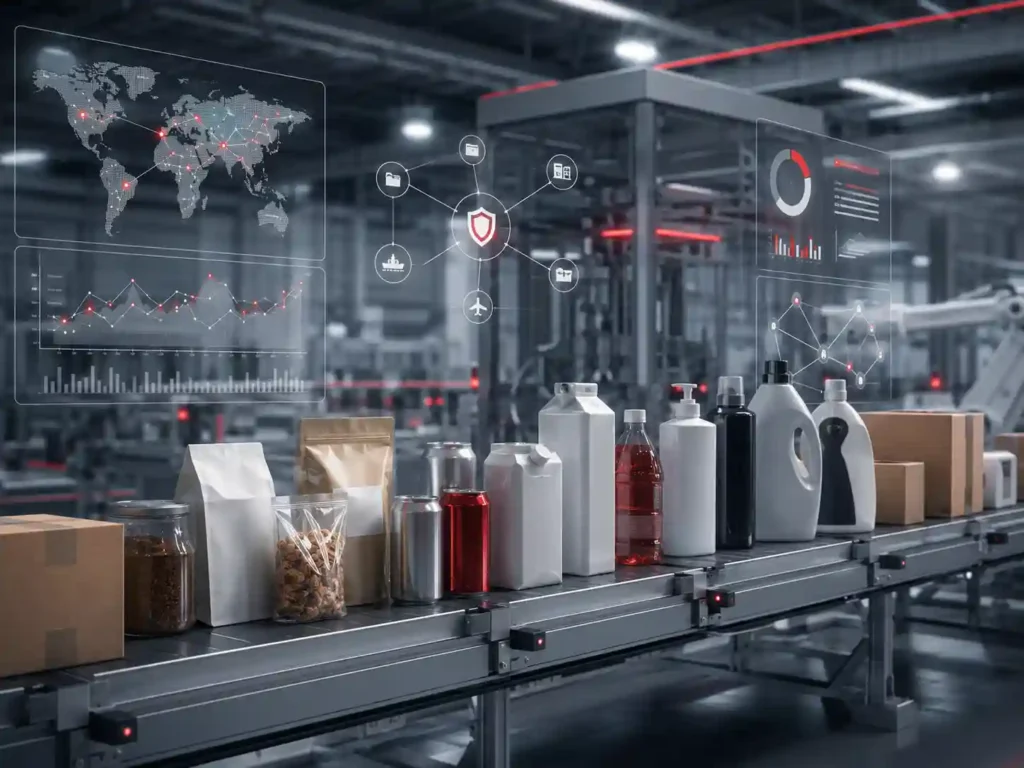
Regulatory framework for the consumer goods industry
Manufacturers face demanding regulatory requirements such as REACH, the product safety law, the Packaging Ordinance (VerpackG), and expanded CE labeling requirements.. The bar for audit-proof documentation and complete proof of compliance is rising continuously. These obstacles can only be overcome through transparent responsibilities and digitized control mechanisms..
Content
Managing risks in the consumer goods industry effectively
Global procurement networks encounter pronounced cost sensitivity
The international consumer goods industry is undergoing a phase of profound structural transformation. Significant price fluctuations in the commodity markets, volatile transport capacities, and unpredictable supply chain disruptions have significantly increased the financial pressure on margins and operational production processes.. In this dynamic market environment, the ability to mathematically accurately quantify and preemptively mitigate multifaceted procurement and sales risks determines economic stability or the threat of existential losses.. Traditional island solutions reach their functional limits here – a holistic, integrated Enterprise Risk Management (ERM).
Regulatory complexity: REACH, product safety and extended CE requirements
In addition to the purely operational challenges in the supply chain, an increasing flood of regulatory requirements increases the pressure on brand manufacturers.. Stricter REACH regulations, the Product Safety Act, the Packaging Ordinance (VerpackG), and comprehensive sustainability and environmental protection regulations. ESG-Reporting obligations require complete proof. These demanding governance requirements now extend deep into the entire product lifecycle, including the sourcing of pre-production materials and the quality and origin documentation of manufacturing..
„Anyone who still controls quality, safety and ESG risks in modern production today by isolating them through manual lists risks not only costly product recalls and penalties, but also the loss of their market-compliant distribution license.“
The limitations of isolated ERM tools in dynamic project phases
The biggest weakness of many construction and real estate companies is isolated software silos. Controlling plans construction costs in ERP systems, the data protection officer maintains manual lists, and the compliance officer handles internal audits. ESG-The team collects data via email, and the purchasing department blindly deals with supplier risks. This lack of connectivity prevents a valid risk assessment and makes strategic decisions a flight of the blind. With OPTURE RegOS The platform will provide this patchwork with a Single Source of Truth replaced.
The 10 biggest risks for the consumer goods industry
Financial leverage: Keep raw material, procurement and price risks under control
The procurement markets for consumer goods producers are inherently volatile. The central material hazards include (1) Commodity and price risks for plastics, metals or chemicals, (2) Acute availability risks as well as (3) Unforeseeable energy price risks. With OPTURE ERM Advanced These financial threats are not only assessed qualitatively but also predicted based on simulations using stochastic calculation methods.. Management sees in real time the probability of cost structures being breached and the amount of the necessary risk buffer that must be set aside..
Supply chain volatility: When transport networks and commodity prices become bottlenecks
Dependence on international logistics chains, severe bottlenecks on transport routes, and geopolitical tensions can severely block time-to-market.. In addition to that, there is also the (4) Volatility risk in freight capacities as well as the (5) computational risk of failure of critical core suppliers. The integrated system OPTURE IKS It enables the entire procurement network and the operational quality of the suppliers to be monitored in a comprehensive and audit-compliant manner.. Supply risks are automatically linked to production planning, allowing strategic sourcing alternatives to be initiated early on..
Regulatory, product safety and sustainability risks
The industrial production of consumer goods is subject to strict control requirements. This leads to demanding (6) Regulatory sustainability risks (ESG), closely linked to (7) legal product and environmental requirements (such as the product safety law, REACH or the Packaging Ordinance VerpackG), as well as to (8) far-reaching reputational risks in case of quality defects or violations. With OPTURE COM Companies control their entire compliance landscape and automated protection measures centrally. This is complemented by the legally compliant whistleblowing system OPTURE HGS, which promptly detects irregularities or deviations from the process in the plant operation.
Securing quality, manufacturing and production risks
After the development cycle, flawless production determines product success.. There is a threat here (9) Unexpected manufacturing and plant risks (e.g. technical machine failures) as well as (10) Quality and supply chain risks due to material deviations, which can lead to costly recalls or returns. Our integrated risk platform seamlessly translates IoT data and anomaly analysis into quality management to proactively coordinate maintenance intervals and ensure production stability..
Digitization and cyber resilience as a new foundation
IT security for connected production systems, ERP and IoT data flows (NIS2)
Modern consumer goods companies are based on highly interconnected manufacturing structures.. Automated manufacturing networks (MES), smart IoT sensors, quality management systems (QMS), and integrated ERP environments provide enormous efficiency advantages, but they also increase the technological attack surface.. The module OPTURE ISMS is tailored to fully conform to NIS2 standards for information security in the production network. It locates technological vulnerabilities in IT/OT assets, coordinates security controls, and ensures the required reporting capability in the event of cyber incidents.
Data protection tailored to your needs: GDPR compliance for product and employee data
Whether it involves the management of sensitive recipe data, development documents, or the storage of personal employee data – highly sensitive data is also processed in the consumer goods industry.. The system OPTURE DSMS automates the creation of processing inventories (VVT), coordinates structured deletion concepts and guarantees seamless GDPR compliance to reliably avoid sensitive fines across the entire corporate network.
Risk management for FMCG and durable goods
Use Case 1: Central risk management for global supply chains and production
Manufacturers of consumer goods are highly dependent on international supply chains, raw material prices, energy prices, transport capacities, and quality of suppliers. Volatility directly affects margins, production planning, and time-to-market. With OPTURE RegOS and OPTURE ERM supply chain risks, raw material volatility, production risks, and quality requirements are bundled into an integrated platform. This creates a transparent foundation for resilient processes, better planning, and stable global supply chains.
Use Case 2: Automated risk reviews for quality, compliance, and sustainability
REACH, the Product Safety Act, the VerpackG (packaging law), CE requirements and sustainability requirements increase the regulatory complexity in the consumer goods industry. At the same time, short innovation cycles, new products and high market pressure require rapid assessment of risks along the entire product lifecycle. With OPTURE RegOS Risks, quality standards, proofs, and governance processes are centrally documented and auditable. This reduces manual reconciliations and creates consistent transparency regarding products, suppliers, and regulatory requirements.
„Consumer goods manufacturers are winning with OPTURE RegOS a central basis for structured assessment, audit-capable documentation, and early management of supply chain risks, quality requirements, sustainability requirements, and production risks.“
FAQ
Everything you need to know about the OPTURE solution for the consumer goods industry – explained in a compact way
How OPTURE supports the management of global supply chain risks
Through standardized supplier evaluations, mathematical early warning indicators, and predictive scenario simulations for global procurement networks
How does OPTURE help with product safety and sustainability requirements?
Through automated compliance controls and a fully audit-proof document management system for REACH, VerpackG and ESG requirements.
How does OPTURE integrate with production and ERP systems?
Through flexible data interfaces directly to your system landscape from ERP, production control systems (MES), quality management (QMS), SCM, and IoT data sources.
How does OPTURE improve governance in production networks?
Through seamless, centralized documentation of all hazards, countermeasures, and internal controls across all manufacturing sites.
How does OPTURE support the management of quality risks?
Through continuous analysis of quality KPIs, automated deviation models, and system-supported workflows for proactive defect reduction.
How fast can OPTURE be implemented?
Complete system integration takes only 4 to 6 weeks and is carried out in an agile manner within the existing operation – modularly expandable for Risk, Compliance and IKS.